

If we lack a desire to personally know Jesus through studying the Bible we will miss out on deeper wisdom to be revealed by God. The result of our actions leave a hole in our faith, a hole in our understanding of the Gospel, a hole in complete understanding of the sermons we sit preached under, a hole in our personal growth, a hole in our life, and a hole in our heart.
As I began a slow and steady study of the Bible five years ago, God began to reveal wisdom to me that can not be known by skimming through the Bible, or randomly picking through scripture to fit the emotion you are feeling or the subject you are in need of guidance. When we randomly pick out scripture without understanding the entire picture of how the scripture works together with the whole Bible, scripture can be taken out of context, or used as proof of a distorted belief that is not truly supported in God’s Word.
For those who only study the New Testament and think the Old Testament is just a nice book of history, not relevant, or worth studying, I pray you will see below how everything in the New Testament is first rooted in the Old Testament. If you view the Bible as two separate books and do not study the Bible as a whole you are missing significant wisdom revealed by God. Be prepared to get a glimpse of the wisdom you are lacking if you do not thoughtfully and carefully study God’s Word.
With Easter approaching, God placed upon my heart, the Passover event in the Old Testament and why Jesus is said to be the Lamb of God. We must, therefore, begin in the Old Testament. Early in the Old Testament the Israelites are said to be God’s chosen people through whom God would send the Messiah (Jesus). The Israelites eventually settled in Egypt and, over time, grew in number. They were believed to have grown to a total of over two million. The Egyptian Pharaoh became fearful that if there were a war, the Israelites would join the enemies. He decided to oppress them, hoping to reduce their number by forced labor. But, Instead of their number reducing, their numbers multiplied.
When this plan failed, Satan moved Pharaoh to have all first born Hebrew males to be put to death. We must remember that there is a spiritual war taking place. Satan does not want Jesus to come to Earth and crush his head and beat death through the fulfilling of God’s plan. Satan also used Herod to kill all the male babies in Bethlehem at the time of the birth of Jesus. We must stay focused on who our enemy truly is because we tend to only focus on the person and neglect to remember the spiritual war truly taking place.
The Egyptian mid-wives did not listen to the Pharaoh’s order of murder and allowed babies to live. Moses survived birth, but at three months old, his Mother did not feel she could conceal him any longer. She placed him in a basket, where he was found by and Egyptian Princess. Although she knew he was Hebrew, she decided to save him. God allowed Moses to be raised with the Egyptians. This gave him the Egyptian background to prepare him for the work that lay ahead.
The Egyptians were pagan because they worshiped the creation, rather than the Creator. They worshipped animals such as birds, bulls, cows, crocodiles, and snakes. The Pharaoh was considered a god, although he was truly only human. Because Egypt turned to Satan with their pagan worship, God brought judgment upon Egypt with the ten plagues. Through these plagues God showed them that he is the all powerful true God and their pagan gods did not have any power.
Egyptian’s approximately eighty gods and goddesses centered around the three earthly creations, the Nile, the sun, and the land. The plagues were targeted against these earthly creations and the gods and goddess that centered around each one. The first two plagues were directed against the gods and goddesses of the Nile and anything associated with the Nile. Four plagues were targeted against the gods and goddesses of the land. The last four were targeted against the gods and goddesses of the sky and anything associated with the sky.
The Pharaoh was thought to be the earthly incarnation of the sun god, Ra, so the tenth plague, death of the firstborn, was against the sky. The Pharaoh’s firstborn son would have been the next incarnation of the sun god, Ra. The death of the firstborn was a horrible judgment, but also a fitting judgment. Remember, years earlier, Pharaoh had ordered the death of all male Israelite children. This act from God was not an act of cruelty, it was an act of judgment against the gods they worshipped and the cruel treatment enacted against the Israelites. Not only did the firstborn of all families die, but the firstborn of all the animals also died.
The Israelites received instructions from God to carry out so their firstborn children would be saved on the night this judgment would come upon Egypt. Each Hebrew family was to take a firstborn male lamb from their flock. The lamb had to be one year old and without blemish or spot. It had to be perfect, with no broken bones. The lamb was to be killed at twilight on the specified day and the blood was to be collected. They were to use a brush and spread the blood on both sides of the door frame and on the lintel at the top of the door. These three marks made with blood were to be a sign to God. As the destroyer passed through the land, the households with the sign would not be stricken with death. Those households would be passed over. Death indeed would come to each household, but it would be the death of a lamb, not their firstborn. The lamb was their substitute. This is the origin of Passover.
Each lamb was to be roasted and eaten. Any uneaten parts were to be burned, not eaten. The Israelites were to celebrate Passover with a feast celebration every year, so that their children would ask why they celebrated Passover. This would keep the remembrance of Passover and what God did for His people on the minds of His people for generations.
If Pharaoh would have truly been the incarnate sun god, the most powerful force, he should have been able to save his people from death. But, Pharaoh had no power. He was not a god, nor were any of the other gods they created as their idols of worship. Some of their gods were gods of animals, but they were unable to save the animals, because they were not gods at all. By the carrying out of God’s judgment upon Egypt and their gods, the Egyptians must have realized that their gods of Egypt were nothing and were powerless.
Do not think that the Israelites were special, or did anything to deserve special treatment from God. They were just as sinful and guilty as the Egyptians. If they had not marked their houses with the blood of the lamb, their firstborn children would have also perished. The Bible says they had worshiped other gods just like the Egyptians. We are not special either, or better than another. We are all sinners in need of God’s grace because sin brings the penalty of death.
Without the shedding of blood, there is no forgiveness of sin or salvation. The lamb had to die and his blood had to be shed. This Passover event in the Old Testament points to the coming of Jesus in the New Testament, as the Lamb of God. In the New Testament, Hebrews 10:4 says, “The shed blood of bulls and goats can not take away sin.” This means that these things are a picture, looking forward to the coming of Jesus, who is the perfect sacrifice for our sins. 1 Peter 1:19 says, “….but with the precious blood of Christ, like that of a lamb without blemish or spot.” Paul says in 1 Corinthians 5:7, “…For Christ, our Passover lamb, has been sacrificed.” And, finally, when Jesus approached John the Baptist, John loudly declares in John 1:29, “Behold, the Lamb of God, who takes away the sin of the world.”
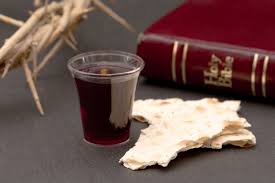
In the New Testament, as the Passover is being celebrated, Jesus meets with his disciples in an upper room. He eats the Passover meal with them and says in Matt 26:26-28, “Jesus took the bread, blessed and broke it, gave it to the disciples and said, “take and eat it; this is my body.” Then he took a cup, and after giving thanks, he gave it to them and said, “Drink from it, all of you. For this is my blood of the covenant, which is poured out for many for the forgiveness of sins.”
In summary:
- In the Old Testament the Israelite families must choose a perfect lamb, without blemish, spot, or broken bones. In the New Testament Jesus is chosen by God. Jesus is perfect, sinless, and dies on the cross without a bone broken.
- Because God is Good and Just, there must be a penalty for sin. That penalty is death. In the Old Testament God is enacting His judgment upon Egypt with the death of their firstborn. God gives the Israelites a lamb to be killed as their substitute instead of the death of their firstborn. These families were passed over by the destroyer. In the New Testament Jesus is our Passover Lamb. He is our substitute, took on our sin, and received the penalty of death that we deserved. By doing this, judgment has passed over us so that we may have eternal life instead of the judgment of Hell.
- In the OT there must be a shedding of blood for the forgiveness of sins. Not only was the lambs blood shed, it was also brushed on their door frames as a sign to God. In ancient times when two men entered into a covenant (a binding agreement) together there was a shedding of animals blood as a sign and seal of the covenant. God continually tells us throughout the OT that He made a covenant with us. That binding covenantal agreement was the promise of eternal life with us. In the NT Jesus’ blood was shed as the payment for the penalty of our sin and also as a sign of the covenant with God. Jesus, fully God and fully Man, shed his own blood to give us life so that we may have eternal life in Heaven with Him.
- In the OT the lamb must be eaten. In the NT Jesus eats a Passover meal with his Disciples and says that the bread is his body and the wine is his blood. They are commanded to eat it in remembrance of Him. Eating the bread and wine also symbolizes the eating of the lamb since Jesus is considered the Lamb of God.
- In the OT the lamb is killed in preparation for death to be passed over them(the Passover). Jesus died on the day of preparation for Passover.
- In the OT The Israelites were to celebrate the Passover with a feast of celebration every year in remembrance of what God did for them. In the NT we are commanded to partake in The Lords Supper in remembrance of what The Lamb of God did for us and as a foretaste of the feast of celebration to come upon His return and our gathering into Heaven for eternity.
The progression of sacrifice:
- Death as a penalty for sin began with Adam and Eve in the garden, with God providing the sacrifice. One animal for each individual.
- During the Passover, the shedding of the blood of the lamb protected a whole family.
- While the Israelites were out in the wilderness, the high priest confessed the sins of an entire nation over an animal before it was killed.
- When Jesus, the Lamb, sacrificed His life, one Lamb took away the sins of the world. God provided the ultimate sacrifice to save us, because we were unable to fulfill the payment due, by sacrificing Himself, his own life, in the person of Jesus.
- This is the progression of sacrifice; individual, family, nation, and the whole world.
If your eyes have been opened to see this wisdom that is also revealed through the study of His word, I pray that you are filled with a desire to begin or continue a thorough study of the Bible. I pray that you will desire to know Jesus personally if you currently do not have a personal relationship with Him.
If the Bible sits on your shelf and looks like a book of foreign language, I recommend that you have a Bible that is a study Bible so that you may read the interpretation along with the scripture. I have an ESV study Bible. If you have never opened the Bible, I recommend that you start with the book of John in the New Testament. If you feel comfortable after reading John, Start with the book of Matthew and read through the New Testament. Once you have your foundation of Jesus I recommend you begin reading in Genesis.
 Susan McCeldry